



Oil hardened and tempered spring steel wire
Oil Tempered Wire, abbreviated as OT wire, This material can achieve a balance between high strength and high toughness. Its excellent fatigue resistance is mainly used in the production of suspension spring and valve spring steel wires. It is irreplaceable in high-end manufacturing such as aerospace and new energy vehicles. In the future, with the application of environmentally friendly quenching oils (such as bio-based oils) and intelligent temperature control technology, its performance will be further enhanced

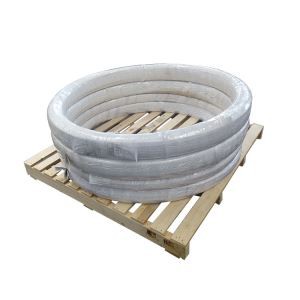


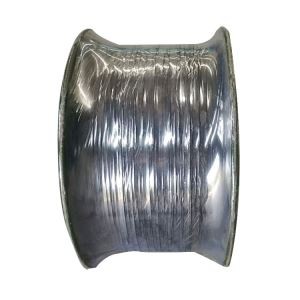


Characteristics of oil tempered wire
High strength and Strong impact resistance
The tensile strength is greater than that of annealed steel wire and cold-drawn steel wire, capable of withstanding significant elastic deformation without permanent failure. It is suitable for spring scenarios that require repeated compression or stretching
Durable, fatigue resistance and Good shock absorption
After oil quenching and tempering, the internal structure of the steel wire is uniform, and it can withstand millions of cyclic loads without fatigue failure. It is commonly used in valve springs, suspension helical springs, compressor valve plate springs .etc
Make the process of producing springs simple
Using oil tempered spring steel wire to make spring can enhance the production efficiency, reduce energy consumption, lower the scrap rate, lower the equipment investment of spring factories, and simplify the production process.
oil tempered wire properties
Oil tempered spring steel wire has a density of approximately 7.80 g/cc. Density in lb/in3: 0.284.
The process involves heating the steel wire to the austenitizing temperature (approximately 850-950℃), rapidly cooling it in oil (quenching), and then tempering at an intermediate temperature (350-500℃) to achieve a uniform sorbite structure, thereby optimizing mechanical properties.
Common types, based on material and application, include:
- Carbon oil tempered steel wire (e.g., 65Mn, 70# steel): Low cost, suitable for general strength requirements.
- Oil tempered alloy steel wire (e.g., 55CrSi, 60Si2Mn): Enhanced with alloying elements to improve strength and toughness.
mechanical property
- High strength: The tensile strength can reach 1800-2200 mpa (depending on the diameter and material), far exceeding that of ordinary annealed steel wire (about 500-800 mpa).
- High elastic limit: It has strong elastic deformation capacity and is not prone to permanent deformation under repeated loads, making it suitable for scenarios such as springs that require elastic recovery.
- Good toughness: The elongation can reach 8%-12%, high impact absorption energy, less prone to brittle fracture (compared with the elongation of water-quenched steel wire of about 5%-8%)
Physical and chemical properties
- Dimensional stability: After quenching and tempering, the internal stress is low and the dimensional accuracy is high (diameter tolerance 0.01-0.05mm), making it suitable for precision components
- Surface quality: During the oil quenching process, an oxide film forms on the surface of the steel wire, which can reduce rust (but additional anti-rust treatment is required to adapt to a humid environment).
- Heat resistance: It can maintain mechanical properties at 200-300 ° C, which is superior to ordinary steel wire (the strength of ordinary steel wire significantly decreases above 150 ° C).
technological adaptability
- Formability: It can be cold-wound into various spring shapes and is not prone to cracking (such as helical springs and coil springs).
- Weldability: For alloy steel wires, the welding process (such as argon arc welding) needs to be controlled to avoid performance degradation in the heat-affected zone
Oil tempered wire grade
American ASTM standards (Common grades)
| Grade | Materials | Application |
|---|---|---|
| ASTM A228 | Oil-quenched carbon spring steel wire | Automobile suspension spring valve spring |
| ASTM A229 | Oil tempered alloy spring steel wire | Heavy machinery springs, industrial shock-absorbing springs |
| ASTM A401 | Valve oil tempering spring steel wire | Engine valve spring |
| ASTM A877 | Oil tempered chrome vanadium valve quality spring wire | It is widely applied in fields where the reliability of springs is highly demanded |
European EN standard
| Grade | Materials | Application |
|---|---|---|
| EN 10270-1 | Oil-quenched carbon steel wire (such as C70E) | Mechanical spring clutch spring |
| EN 10270-2 | oil tempered chrome silicon spring wire | Fields such as automotive manufacturing and aerospace |
| EN 10270-3 | Oil-quenched stainless steel wire (such as X8CrNi18-10) | Food machinery and medical devices |
Chinese GB standard
| Grade | Materials | Application |
|---|---|---|
| GB/T 18983-2003 | Oil-quenched carbon spring steel wire (such as 65Mn) | Automobile seat spring agricultural machinery parts |
| GB/T 22719.1-2008 | Oil tempered alloy spring wire (such as 50CrVA) | High-speed rail shock-absorbing spring aerospace parts |