



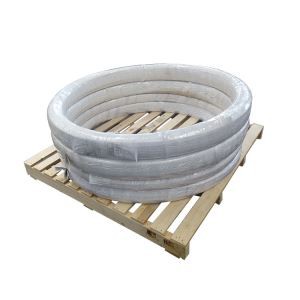
Swosc-hv Oil Quenching And Tempering Spring Steel Wire


Tempering brittleness refers to the phenomenon that toughness of quenched-steel decreases after tempering.
Temper brittleness: hardened steel during tempering, with the increase of tempering temperature, lower hardness, higher toughness, but in many steel tempering temperature and impact toughness in the relation curves of two trough, a between 200 ~ 350 ℃, and another is between 450 ~ 650 ℃.As the tempering temperature increases, the impact toughness decreases. The tempering brittleness can be divided into the first type and the second type.
The first kind of temper brittleness is also called the irreversible temper brittleness, low temperature tempering brittleness, mainly in the tempering temperature is 250 ~ 400 ℃,
Characteristics of the
(1) it is irreversible;(2) has nothing to do with the cooling rate after tempering;(3) the fracture is intergranular brittle fracture.
1. Three opinions on the causes:
(1) residual A transition theory; (2) carbide precipitation theory; (3) impurity segregation theory
2. Prevention methods
It cannot be eliminated. There is no alloy element that can effectively inhibit the generation of such temper brittleness if it is not tempered within this temperature range
(1) reduce the content of impurity elements in steel;
(2) deoxidize Al or add alloying elements such as Nb, V and Ti to refine grain A;
(3) the addition of Mo and W can alleviate the pressure;
(4) add Cr and Si to adjust the temperature range (push to high temperature);
(5) isothermal quenching is adopted instead of quenching and tempering process.
The second type of temper brittleness is also known as reversible temper brittleness and high temperature temper brittleness.The temperature in 400 ~ 650 ℃,
Characteristics of the
(1) reversible;
(2) is related to the cooling rate after tempering;After tempering and heat preservation, slow cooling appears, quick cooling does not appear, and after embrittlement, quick cooling can be eliminated after reheating.
(3) has nothing to do with the state of the organization, but M tends to embrittlement;
(4) temper in the embrittlement zone, and the embrittlement after temper has nothing to do with the cooling rate;
(5) the fracture is intergranular brittle fracture.
3. Factors affecting the second type of temper brittleness
(1) chemical composition (2) A grain size (3) hardness after heat treatment
4. Mechanism of production
(1) in the case of temper brittleness, Ni, Cr, Sb, Sn, P, etc. are all inclined to the original grain boundary of a. they are all concentrated in the grain boundary with 2~3 atomic thickness. The temper brittleness increases with the increase of impurity elements.Ni and Cr not only had self-polymerization, but also promoted the polymerization of impurity elements.(2) for quenching without tempering or tempering without embrittlement, no segregation phenomenon of alloying elements and impurity elements is found.(3) alloying element Mo can inhibit the segregation of impurity elements toward grain boundary A, and it does not bias itself.
The above description: the segregation of Sb, Sn, P and other impurity elements to the original grain boundary of A is the main reason for the second type of temper brittleness, while Ni and Cr not only promote the segregation of impurity elements, but also the segregation itself, thus reducing the fracture strength of grain boundary and producing temper brittleness.
5. Prevention methods
(1) improve the purity of steel and minimize impurities;
(2) add appropriate amount of beneficial alloying elements such as Mo and W;
(3) for parts with small size and simple shape, quick cooling method after tempering is adopted;
(4) subtempering quenching (A1~A3) is adopted to refine grain and reduce segregation.When heated to A+F (F is A fine strip), impurities will be enriched in F, and F has A greater ability to dissolve impurities, which can inhibit the segregation of impurities toward the grain boundary of A.
(5) high-temperature deformation heat treatment is adopted to make the grain superfine, increase the grain boundary area, and reduce the concentration of the impurity elements.
Keywords: metal materials, heat treatment, tempering, brittleness
Hot Tags: swosc-hv oil quenching and tempering spring steel wire China, manufacturer, customized, made in China, 50crva oil tempered wire, 50crva oil tempered spring steel wire, 1069 Oil quenched and tempered spring steel wire, 60si2mna oil quenching spring steel wire, Cold drawn wire, tempered spring steel wire factory
You Might Also Like


Send Inquiry